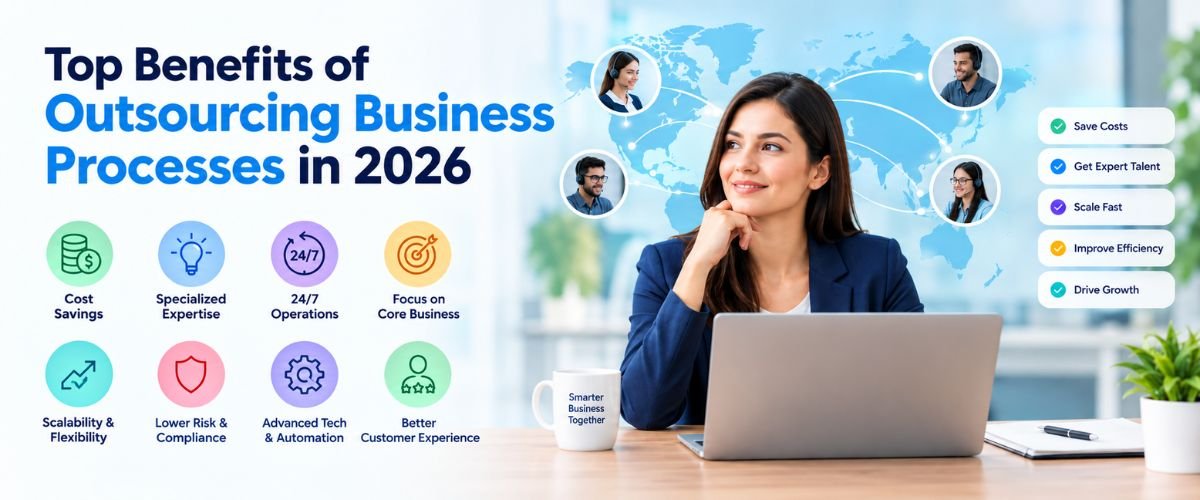
Top Benefits of Outsourcing Business Processes in 2026
Business process outsourcing (BPO) is no longer just about cutting costs. It is become a way for companies to access specialized skills, modern tools, and round-the-clock operations without the overhead of building every function in-house. For instance, many businesses start their outsourcing journey with a Customer Support Outsourcing Service in Noida, since customer-facing functions are often the easiest to hand off with immediate, measurable results.
What Is Business Process Outsourcing?
Business process outsourcing means contracting a specific business function — such as customer support, data entry, accounting, digital marketing, or lead management — to a specialized third-party provider, instead of hiring and managing an internal team for that function.
BPO generally falls into a few categories:
- Back-office outsourcing — data entry, payroll, HR administration, bookkeeping
- Front-office outsourcing — customer support, sales, technical helpdesks
- Knowledge process outsourcing (KPO) — research, analytics, specialized judgment-based work
- IT outsourcing (ITO) — software development, infrastructure management, cybersecurity
Most companies don't outsource everything — they identify specific, well-defined processes that are repetitive or resource-intensive, and hand those off while keeping strategic and customer-facing decisions in-house.
Benefits of Outsourcing Business Processes
1. Significant Cost Savings
Cost reduction remains the number one reason companies outsource. When you hire in-house, you are not just paying a salary — you are covering benefits, office space, equipment, software licenses, training, and management overhead. Outsourcing converts most of these fixed costs into a variable, predictable expense.
Many businesses report operational cost reductions in the range of 30–60% after outsourcing back-office and support functions, depending on the process and provider location. This isn't just about paying lower rates — it is about not having to build and maintain infrastructure for work that doesn't need to happen in-house.
Practical example: A company running an in-house data entry team might pay for salaries, a workspace, computers, and a manager to oversee them. Outsourcing the same function shifts that cost to a per-task or per-hour rate, with no idle-time cost when volume dips.
2. Access to Specialized Expertise
Outsourcing partners work across many clients and industries, which means they've already solved problems your internal team may be encountering for the first time. This is especially valuable in fast-moving fields — SEO, paid ad management, CRM/lead analytics, and marketing automation all change quickly, and a dedicated external team is more likely to stay current than a generalist in-house hire juggling multiple responsibilities.
Instead of spending months training an employee on a new discipline, you get immediate access to people who've already built that expertise across dozens of similar projects.
3. Faster Turnaround & 24/7 Operations
When you outsource to a partner in a different time zone, work can continue after your internal team logs off. This is particularly useful for customer support, where response time directly affects satisfaction, and for data processing tasks with tight deadlines.
Even without time-zone differences, dedicated outsourcing teams typically have streamlined workflows built specifically for speed — because turnaround time is often part of their service agreement.
4. Greater Focus on Core Business Activities
Every hour your team spends on repetitive, non-core tasks is an hour not spent on strategy, product improvement, or revenue-generating work. Outsourcing routine functions — payroll, data entry, lead follow-ups, basic reporting — frees up internal bandwidth for the work that actually differentiates your business.
This is one of the most underrated benefits: it's not just about saving money, it's about redirecting your best people toward higher-value work instead of admin tasks.
5. Scalability & Flexibility
Business needs fluctuate — seasonal demand, product launches, sudden growth spurts. Scaling an in-house team up or down is slow and expensive: hiring takes weeks, and layoffs carry both financial and morale costs.
Outsourcing partners can typically scale support up or down within days, because they already have trained staff available. This flexibility is especially valuable for businesses with unpredictable workloads, like real estate firms managing seasonal lead spikes or e-commerce brands during peak sale periods.
6. Reduced Operational Risk & Better Compliance
Established outsourcing providers work with multiple clients across regulated industries, which means they've already built in data protection practices, audit trails, and compliance processes. For a smaller internal team managing everything from scratch, matching that level of process maturity can take years.
That said, this benefit only holds true when you choose a provider with a verifiable track record — it's worth asking any prospective partner about their data security certifications and compliance history before signing on.
7. Access to Advanced Technology & Automation
Modern BPO providers invest heavily in automation, AI-driven tools, and analytics platforms — and that investment gets passed on to clients without the client needing to purchase or maintain the software themselves.
In 2026, this is increasingly the norm rather than the exception: automation now handles much of the repetitive work in areas like data entry and basic customer queries, while outsourcing teams focus their human effort on exceptions and higher-judgment tasks. This combination — automation plus specialized staff — often delivers faster, more accurate results than an internal team without the same tools.
8. Improved Customer Experience
When support, order processing, and follow-ups are handled by specialists with clear SLAs and quality metrics, customers typically experience faster response times and fewer errors. An internal team stretched across too many responsibilities often can't match that level of consistency, simply because customer support isn't their sole focus.
Which Business Processes Should You Outsource First?
Not every function is a good outsourcing candidate, and picking the wrong one first can sour a business on outsourcing entirely. A simple decision framework:
Good candidates for outsourcing:
- Repetitive and rule-based (data entry, basic support tickets, payroll processing)
- Does not require your physical presence or deep institutional knowledge
- Has clear, measurable success criteria (turnaround time, accuracy rate, volume handled)
- Currently consuming disproportionate internal time relative to its strategic value
Better kept in-house:
- Requires deep product or company-specific knowledge
- Involves sensitive strategic decisions
- Needs constant face-to-face collaboration with leadership
Common Challenges of Outsourcing
Communication gaps: Time zone differences and unclear expectations can lead to misaligned deliverables. Mitigate this with documented processes, regular check-ins, and a single point of contact on both sides.
Inconsistent quality: Providers juggling many clients may not give every account the same attention. Address this with clear SLAs, quality benchmarks, and periodic audits of the work delivered.
Loss of direct control: Handing off a process can feel like losing visibility. Dashboards, regular reporting, and defined escalation paths help maintain oversight without micromanaging.
Data security concerns: Sharing business or customer data with an external party carries inherent risk. Vet any provider's security certifications, data handling policies, and contractual protections before sharing sensitive information.
None of these are reasons to avoid outsourcing altogether — they're reasons to choose a partner carefully and set clear expectations from the start.
Frequently Asked Questions
Is outsourcing worth it for a small business?
Yes. Outsourcing gives small businesses access to expertise and tools they couldn't otherwise afford as full-time hires, and it lets them scale support without the risk of over-hiring.
What's the difference between BPO, KPO, and ITO?
BPO covers general business functions like support, data entry, and admin work. KPO (knowledge process outsourcing) covers specialized, judgment-based work such as research or advanced analytics. ITO (IT outsourcing) covers technical functions like software development and infrastructure management.
What are the biggest risks of outsourcing?
Communication gaps, inconsistent quality, and data security concerns are the most commonly cited risks. All three are manageable through clear contracts, defined SLAs, and regular oversight.
Which business functions should you avoid outsourcing?
Functions requiring deep institutional knowledge, sensitive strategic decision-making, or constant in-person collaboration with leadership are usually better kept in-house.
How much money can a company actually save by outsourcing?
Reported savings vary by function and provider, but many businesses see operational cost reductions in the 30–60% range for back-office and support functions.
How do you choose the right BPO partner?
Look for proven experience in your specific industry, transparent and regular reporting, strong data security practices, and references or case studies from clients with similar needs.
Does outsourcing hurt customer experience?
Not when managed correctly — in many cases it improves it, since dedicated specialists with clear SLAs often deliver faster, more consistent service than an internal team stretched across multiple responsibilities.